DRAG DROP -
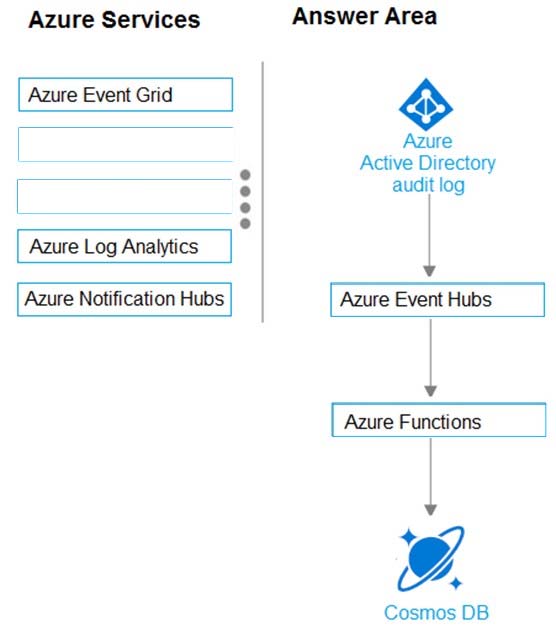
You need to design an architecture to capture the creation of users and the assignment of roles. The captured data must be stored in Azure Cosmos DB.
Which Azure services should you include in the design? To answer, drag the appropriate services to the correct targets. Each service may be used once, more than once, or not at all. You may need to drag the split bar between panes or scroll to view content.
NOTE: Each correct selection is worth one point.
Select and Place: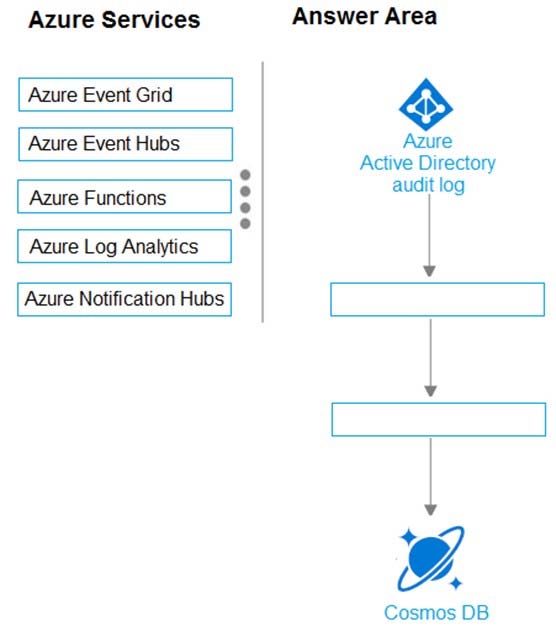
Correct Answer:
You are developing a web application that provides streaming video to users. You configure the application to use continuous integration and deployment.
The app must be highly available and provide a continuous streaming experience for users.
You need to recommend a solution that allows the application to store data in a geographical location that is closest to the user.
What should you recommend?
Correct Answer:
D
Azure Content Delivery Network (CDN) is a global CDN solution for delivering high-bandwidth content. It can be hosted in Azure or any other location. With Azure
CDN, you can cache static objects loaded from Azure Blob storage, a web application, or any publicly accessible web server, by using the closest point of presence (POP) server. Azure CDN can also accelerate dynamic content, which cannot be cached, by leveraging various network and routing optimizations.
References:
https://docs.microsoft.com/en-in/azure/cdn/
HOTSPOT -
Your company deploys an Azure App Service Web App.
During testing the application fails under load. The application cannot handle more than 100 concurrent user sessions. You enable the Always On feature. You also configure auto-scaling to increase counts from two to 10 based on HTTP queue length.
You need to improve the performance of the application.
Which solution should you use for each application scenario? To answer, select the appropriate options in the answer area.
NOTE: Each correct selection is worth one point.
Hot Area: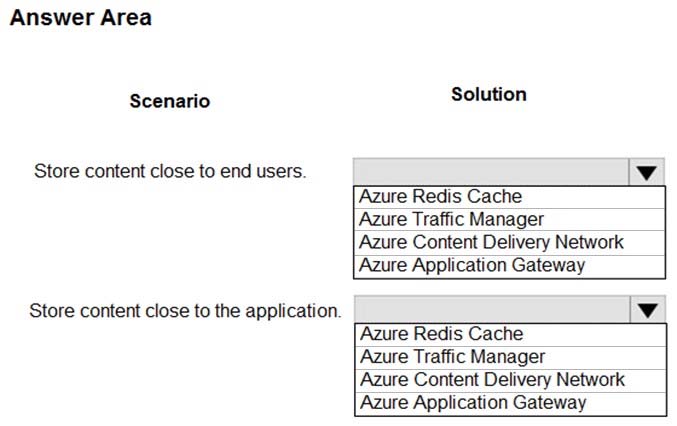
Correct Answer:
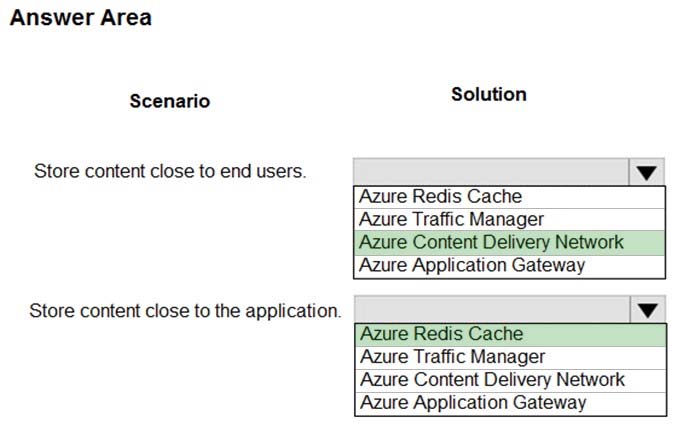
Box 1: Content Delivery Network -
A content delivery network (CDN) is a distributed network of servers that can efficiently deliver web content to users. CDNs store cached content on edge servers in point-of-presence (POP) locations that are close to end users, to minimize latency.
Azure Content Delivery Network (CDN) offers developers a global solution for rapidly delivering high-bandwidth content to users by caching their content at strategically placed physical nodes across the world. Azure CDN can also accelerate dynamic content, which cannot be cached, by leveraging various network optimizations using CDN POPs. For example, route optimization to bypass Border Gateway Protocol (BGP).
Box 2: Azure Redis Cache -
Azure Cache for Redis is based on the popular software Redis. It is typically used as a cache to improve the performance and scalability of systems that rely heavily on backend data-stores. Performance is improved by temporarily copying frequently accessed data to fast storage located close to the application. With
Azure Cache for Redis, this fast storage is located in-memory with Azure Cache for Redis instead of being loaded from disk by a database.
References:
https://docs.microsoft.com/en-us/azure/azure-cache-for-redis/cache-overview
Note: This question is part of series of questions that present the same scenario. Each question in the series contains a unique solution that might meet the stated goals. Some question sets might have more than one correct solution, while others might not have a correct solution.
After you answer a question in this section, you will NOT be able to return to it. As a result, these questions will not appear in the review screen.
You need to deploy resources to host a stateless web app in an Azure subscription. The solution must meet the following requirements:
✑ Provide access to the full .NET framework.
✑ Provide redundancy if an Azure region fails.
✑ Grant administrators access to the operating system to install custom application dependencies.
Solution: You deploy a web app in an Isolated App Service plan.
Does this meet the goal?
Correct Answer:
B
Instead, you should deploy an Azure virtual machine to two Azure regions, and you create a Traffic Manager profile.
You are designing an Azure solution.
The network traffic for the solution must be securely distributed by providing the following features:
HTTPS protocol -
✑ Round robin routing
✑ SSL offloading
You need to recommend a load balancing option.
What should you recommend?
Correct Answer:
D
If you are looking for Transport Layer Security (TLS) protocol termination ("SSL offload") or per-HTTP/HTTPS request, application-layer processing, review
Application Gateway.
Application Gateway is a layer 7 load balancer, which means it works only with web traffic (HTTP, HTTPS, WebSocket, and HTTP/2). It supports capabilities such as SSL termination, cookie-based session affinity, and round robin for load-balancing traffic. Load Balancer load-balances traffic at layer 4 (TCP or UDP).
References:
https://docs.microsoft.com/en-us/azure/application-gateway/application-gateway-faq