You deploy Azure App Service Web Apps that connect to on-premises Microsoft SQL Server instances by using Azure ExpressRoute. You plan to migrate the
SQL Server instances to Azure.
Migration of the SQL Server instances to Azure must:
✑ Support automatic patching and version updates to SQL Server.
✑ Provide automatic backup services.
✑ Allow for high-availability of the instances.
✑ Provide a native VNET with private IP addressing.
✑ Encrypt all data in transit.
✑ Be in a single-tenant environment with dedicated underlying infrastructure (compute, storage).
You need to migrate the SQL Server instances to Azure.
Which Azure service should you use?
Correct Answer:
D
Azure SQL Database Managed Instance configured for Hybrid workloads. Use this topology if your Azure SQL Database Managed Instance is connected to your on-premises network. This approach provides the most simplified network routing and yields maximum data throughput during the migration.
Reference:
https://docs.microsoft.com/en-us/azure/dms/resource-network-topologies
You plan to store data in Azure Blob storage for many years. The stored data will be accessed rarely.
You need to ensure that the data in Blob storage is always available for immediate access. The solution must minimize storage costs.
Which storage tier should you use?
Correct Answer:
A
Data in the cool access tier can tolerate slightly lower availability, but still requires high durability, retrieval latency, and throughput characteristics similar to hot data. For cool data, a slightly lower availability service-level agreement (SLA) and higher access costs compared to hot data are acceptable trade-offs for lower storage costs.
Incorrect Answers:
B: Archive storage stores data offline and offers the lowest storage costs but also the highest data rehydrate and access costs.
Archive - Optimized for storing data that is rarely accessed and stored for at least 180 days with flexible latency requirements (on the order of hours).
Reference:
https://docs.microsoft.com/en-us/azure/storage/blobs/storage-blob-storage-tiers
DRAG DROP -
You are designing a virtual machine that will run Microsoft SQL Server and will contain two data disks. The first data disk will store log files, and the second data disk will store data. Both disks are P40 managed disks.
You need to recommend a caching policy for each disk. The policy must provide the best overall performance for the virtual machine while preserving integrity of the SQL data and logs.
Which caching policy should you recommend for each disk? To answer, drag the appropriate policies to the correct disks. Each policy may be used once, more than once, or not at all. You may need to drag the split bar between panes or scroll to view content.
Select and Place: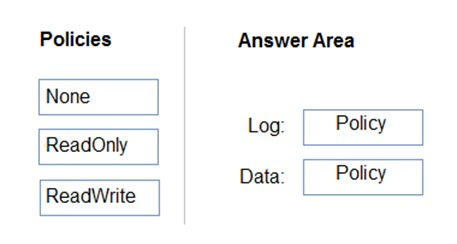
Correct Answer:
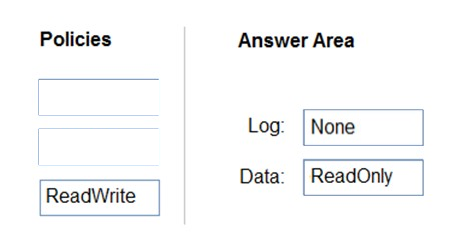
Reference:
https://docs.microsoft.com/en-us/azure/virtual-machines/windows/sql/virtual-machines-windows-sql-performance
You are designing a SQL database solution. The solution will include 20 databases that will be 20 GB each and have varying usage patterns.
You need to recommend a database platform to host the databases. The solution must meet the following requirements:
✑ The compute resources allocated to the databases must scale dynamically.
✑ The solution must meet an SLA of 99.99% uptime.
✑ The solution must have reserved capacity.
✑ Compute charges must be minimized.
What should you include in the recommendation?
Correct Answer:
D
Azure SQL Database elastic pools are a simple, cost-effective solution for managing and scaling multiple databases that have varying and unpredictable usage demands. The databases in an elastic pool are on a single server and share a set number of resources at a set price. Elastic pools in Azure SQL Database enable
SaaS developers to optimize the price performance for a group of databases within a prescribed budget while delivering performance elasticity for each database.
Guaranteed 99.995 percent uptime for SQL Database
Reference:
https://docs.microsoft.com/en-us/azure/azure-sql/database/elastic-pool-overview https://azure.microsoft.com/en-us/pricing/details/sql-database/elastic/