You have a .NET web service named Service1 that has the following requirements:
✑ Must read and write temporary files to the local file system.
✑ Must write to the Application event log.
You need to recommend a solution to host Service1 in Azure. The solution must meet the following requirements:
✑ Minimize maintenance overhead.
✑ Minimize costs.
What should you include in the recommendation?
Correct Answer:
C
You are designing a microservices architecture that will support a web application.
The solution must meet the following requirements:
✑ Allow independent upgrades to each microservice.
✑ Deploy the solution on-premises and to Azure.
✑ Set policies for performing automatic repairs to the microservices.
✑ Support low-latency and hyper-scale operations.
You need to recommend a technology.
Correct Answer:
C
Azure Service Fabric is a distributed systems platform that makes it easy to package, deploy, and manage scalable and reliable microservices and containers.
You can use Azure Service Fabric to create Service Fabric clusters on any virtual machines or computers running Windows Server.
Reference:
https://docs.microsoft.com/en-us/azure/service-fabric/service-fabric-overview
Your company has the infrastructure shown in the following table.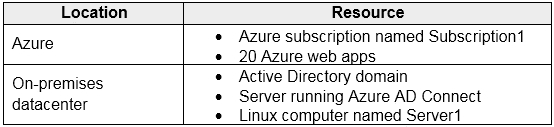
The on-premises Active Directory domain syncs to Azure Active Directory (Azure AD).
Server1 runs an application named App1 that uses LDAP queries to verify user identities in the on-premises Active Directory domain.
You plan to migrate Server1 to a virtual machine in Subscription1.
A company security policy states that the virtual machines and services deployed to Subscription1 must be prevented from accessing the on-premises network.
You need to recommend a solution to ensure that App1 continues to function after the migration. The solution must meet the security policy.
What should you include in the recommendation?
Correct Answer:
D
You can join a Windows Server virtual machine to an Azure Active Directory Domain Services managed domain.
Reference:
https://docs.microsoft.com/en-us/azure/active-directory-domain-services/join-windows-vm
HOTSPOT -
Your company deploys an Azure App Service Web App.
During testing the application fails under load. The application cannot handle more than 100 concurrent user sessions. You enable the Always On feature. You also configure auto-scaling to increase instance counts from two to 10 based on HTTP queue length.
You need to improve the performance of the application.
Which solution should you use for each application scenario? To answer, select the appropriate options in the answer area.
NOTE: Each correct selection is worth one point.
Hot Area: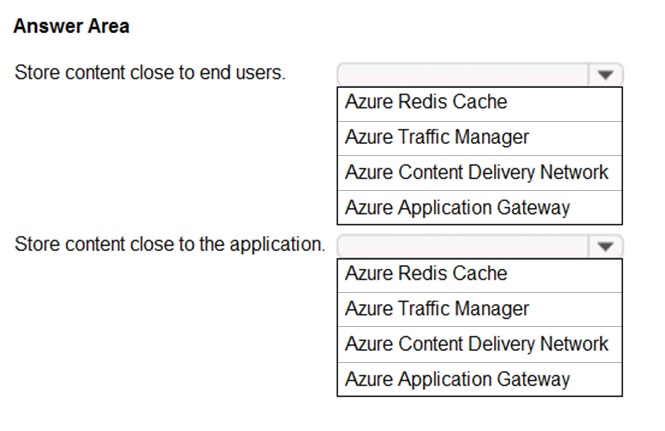
Correct Answer:
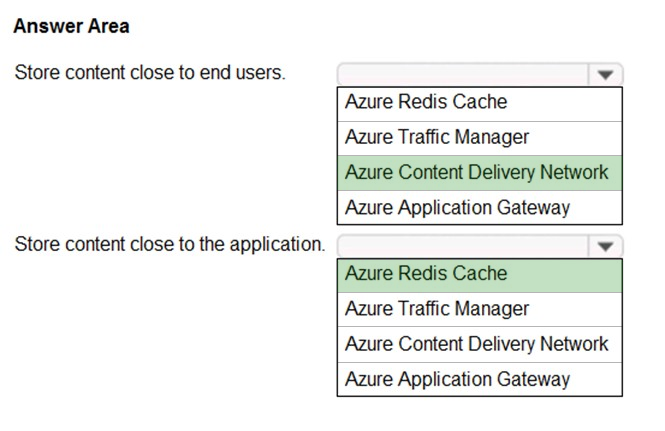
Box 1: Content Delivery Network -
A content delivery network (CDN) is a distributed network of servers that can efficiently deliver web content to users. CDNs store cached content on edge servers in point-of-presence (POP) locations that are close to end users, to minimize latency.
Azure Content Delivery Network (CDN) offers developers a global solution for rapidly delivering high-bandwidth content to users by caching their content at strategically placed physical nodes across the world. Azure CDN can also accelerate dynamic content, which cannot be cached, by leveraging various network optimizations using CDN POPs. For example, route optimization to bypass Border Gateway Protocol (BGP).
Box 2: Azure Redis Cache -
Azure Cache for Redis is based on the popular software Redis. It is typically used as a cache to improve the performance and scalability of systems that rely heavily on backend data-stores. Performance is improved by temporarily copying frequently accessed data to fast storage located close to the application. With
Azure Cache for Redis, this fast storage is located in-memory with Azure Cache for Redis instead of being loaded from disk by a database.
Reference:
https://docs.microsoft.com/en-us/azure/azure-cache-for-redis/cache-overview