Note: This question is part of a series of questions that present the same scenario. Each question in the series contains a unique solution that might meet the stated goals. Some question sets might have more than one correct solution, while others might not have a correct solution.
After you answer a question in this section, you will NOT be able to return to it. As a result, these questions will not appear in the review screen.
You plan to deploy multiple instances of an Azure web app across several Azure regions.
You need to design an access solution for the app. The solution must meet the following replication requirements:
✑ Support rate limiting.
✑ Balance requests between all instances.
✑ Ensure that users can access the app in the event of a regional outage.
Solution: You use Azure Traffic Manager to provide access to the app.
Does this meet the goal?
Note: This question is part of a series of questions that present the same scenario. Each question in the series contains a unique solution that might meet the stated goals. Some question sets might have more than one correct solution, while others might not have a correct solution.
After you answer a question in this section, you will NOT be able to return to it. As a result, these questions will not appear in the review screen.
You need to deploy resources to host a stateless web app in an Azure subscription. The solution must meet the following requirements:
✑ Provide access to the full .NET framework.
✑ Provide redundancy if an Azure region fails.
✑ Grant administrators access to the operating system to install custom application dependencies.
Solution: You deploy two Azure virtual machines to two Azure regions, and you create a Traffic Manager profile.
Does this meet the goal?
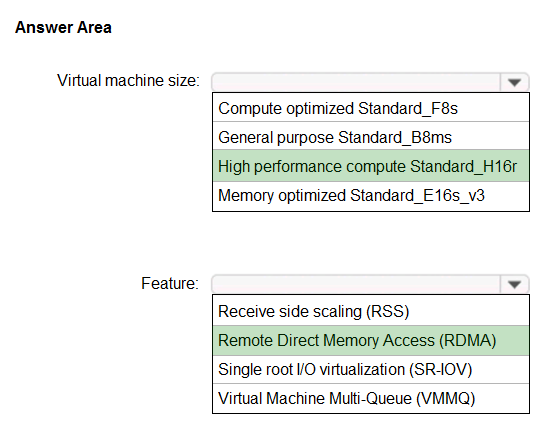
HOTSPOT -
You plan to deploy a network-intensive application to several Azure virtual machines.
You need to recommend a solution that meets the following requirements:
✑ Minimizes the use of the virtual machine processors to transfer data
✑ Minimizes network latency
Which virtual machine size and feature should you use? To answer, select the appropriate options in the answer area.
NOTE: Each correct selection is worth one point.
Hot Area: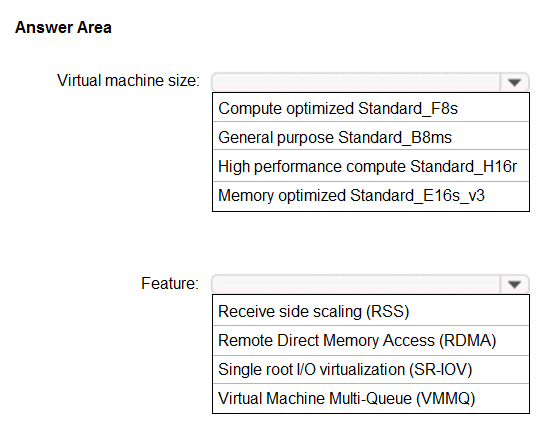
You need to recommend a solution to deploy containers that run an application. The application has two tiers. Each tier is implemented as a separate Docker
Linux-based image. The solution must meet the following requirements:
✑ The front-end tier must be accessible by using a public IP address on port 80.
✑ The backend tier must be accessible by using port 8080 from the front-end tier only.
✑ Both containers must be able to access the same Azure file share.
✑ If a container fails, the application must restart automatically.
✑ Costs must be minimized.
What should you recommend using to host the application?
Correct Answer:
C
Azure Container Instances enables a layered approach to orchestration, providing all of the scheduling and management capabilities required to run a single container, while allowing orchestrator platforms to manage multi-container tasks on top of it.
Because the underlying infrastructure for container instances is managed by Azure, an orchestrator platform does not need to concern itself with finding an appropriate host machine on which to run a single container.
Azure Container Instances can schedule both Windows and Linux containers with the same API.
Orchestration of container instances exclusively
Because they start quickly and bill by the second, an environment based exclusively on Azure Container Instances offers the fastest way to get started and to deal with highly variable workloads.
Reference:
https://docs.microsoft.com/en-us/azure/container-instances/container-instances-overview https://docs.microsoft.com/en-us/azure/container-instances/container-instances-orchestrator-relationship