You plan to store data in Azure Blob storage for many years. The stored data will be accessed rarely.
You need to ensure that the data in Blob storage is always available for immediate access. The solution must minimize storage costs.
Which storage tier should you use?
Correct Answer:
A
Azure cool tier is equivalent to the Amazon S3 Infrequent Access (S3-IA) storage in AWS that provides a low cost high performance storage for infrequently access data.
Note: Azure's cool storage tier, also known as Azure cool Blob storage, is for infrequently-accessed data that needs to be stored for a minimum of 30 days.
Typical use cases include backing up data before tiering to archival systems, legal data, media files, system audit information, datasets used for big data analysis and more.
The storage cost for this Azure cold storage tier is lower than that of hot storage tier. Since it is expected that the data stored in this tier will be accessed less frequently, the data access charges are high when compared to hot tier. There are no additional changes required in your applications as these tiers can be accessed using APIs in the same manner that you access Azure storage.
Incorrect Answers:
B: Even though Azure archive storage offers the lowest cost in terms of data storage, its data retrieval charges are higher than that of hot and cool tiers. In fact, the data in the archive tier remains offline until the tier of the data is changed using a process called hydration. The process of hydrating data in the archive storage tier and moving it to either hot or cool tier could take up to 15 hours and, hence, it is only intended for data that can afford that kind of access delay.
C: The storage cost for this Azure cold storage tier is lower than that of hot storage tier.
References:
https://cloud.netapp.com/blog/low-cost-storage-options-on-azure
HOTSPOT -
You have a virtual machine scale set named SS1.
You configure autoscaling as shown in the following exhibit.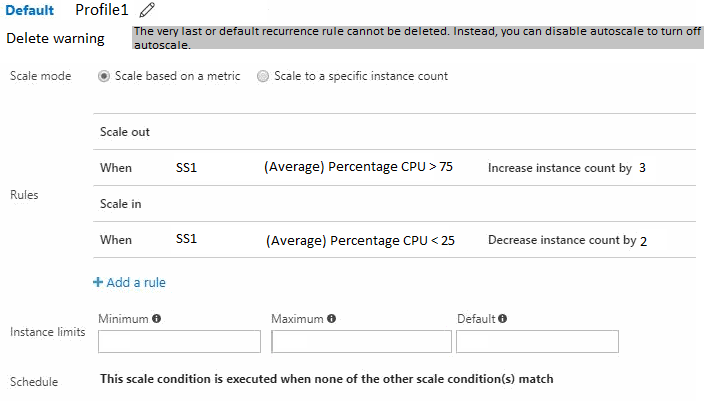
You configure the scale out and scale in rules to have a duration of 10 minutes and a cool down time of 10 minutes.
Use the drop-down menus to select the answer choice that answers each question based on the information presented in the graphic.
NOTE: Each correct selection is worth one point.
Hot Area: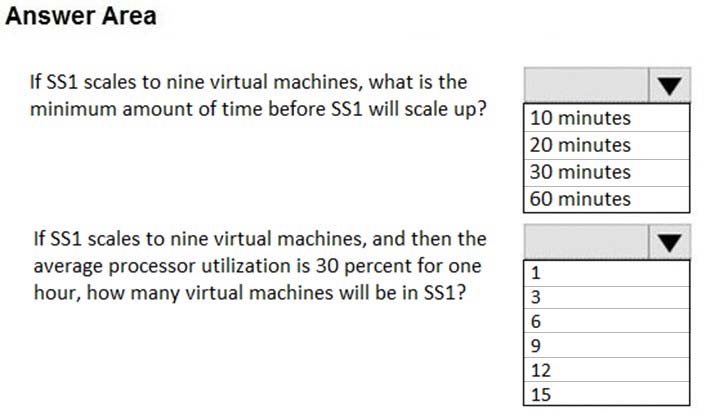
Correct Answer:
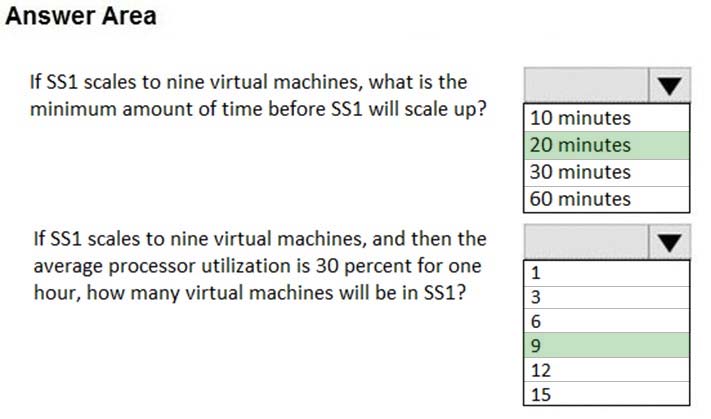
Box 1: 20 Minutes. 10 minutes cool down time after the last scale-up plus 10 minutes duration equals 20 minutes.
Box 2: 9 virtual machines. 30% does not match the scale in requirement of less than 25% so the number of virtual machines will not change.
HOTSPOT -
You have 20 Azure virtual machines that run Windows Server 2016 based on a custom virtual machine image. Each virtual machine hosts an instance of a VSS- capable web app that was developed in-house. Each instance is accessed by using a public endpoint. Each instance uses a separate database. The average database size is 200 GB.
You need to design a disaster recovery solution for individual instances. The solution must meet the following requirements:
✑ Provide a recovery time objective (RTO) of six hours
✑ Provide a recovery point objective (RPO) of eight hours
✑ Support recovery to a different Azure region
✑ Support VSS-based backups
✑ Minimize costs
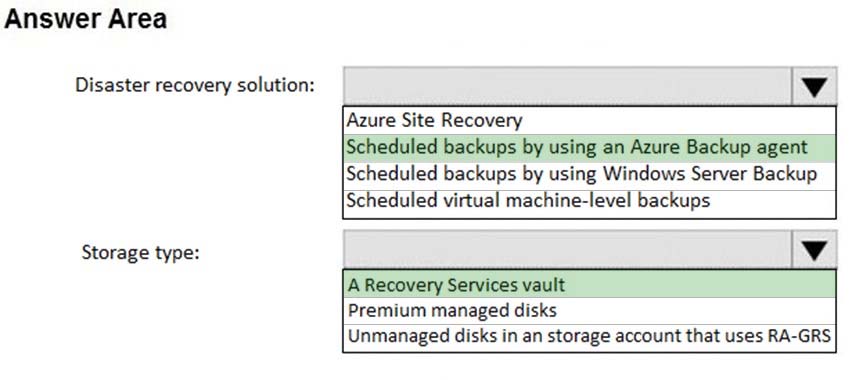
What should you include in the recommendation? To answer, select the appropriate options in the answer area.
NOTE: Each correct selection is worth one point.
Hot Area: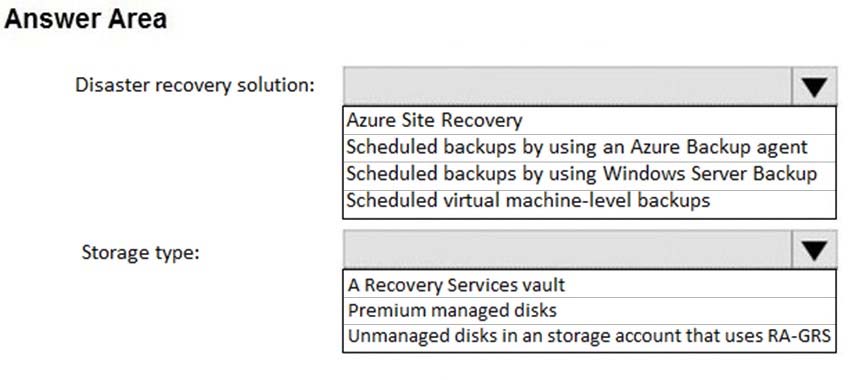
Correct Answer:
HOTSPOT -
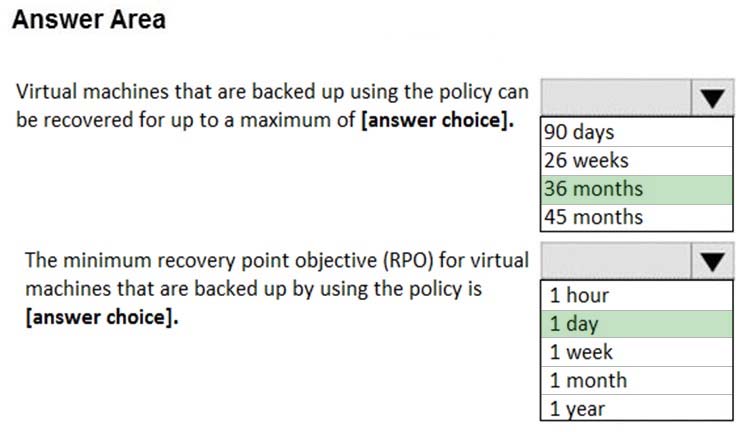
You plan to deploy the backup policy shown in the following exhibit.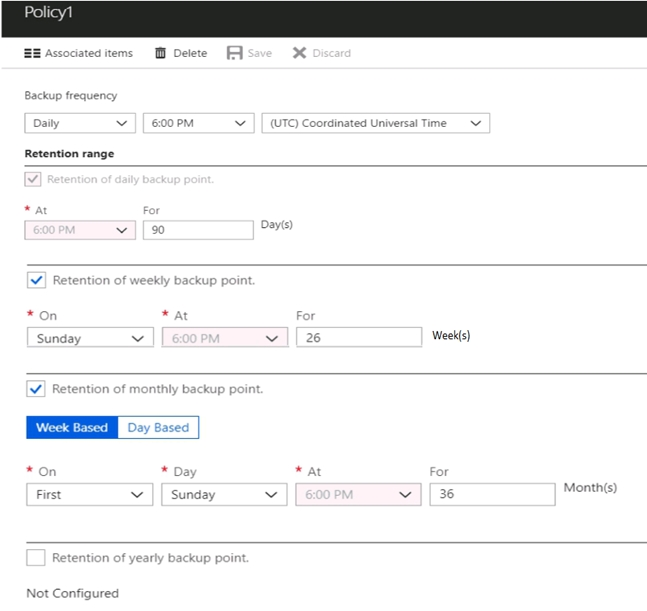
Use the drop-down menus to select the answer choice that completes each statement based on the information presented in the graphic.
NOTE: Each correct selection is worth one point.
Hot Area: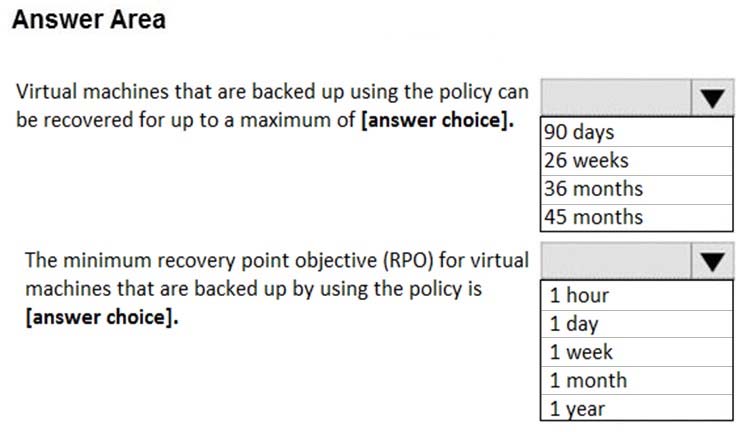
Correct Answer:
HOTSPOT -
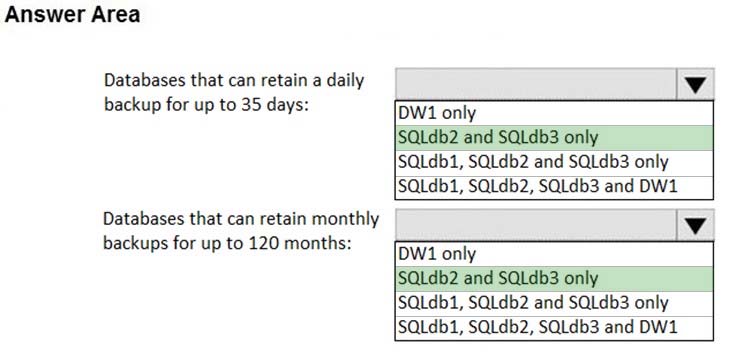
You have databases in Azure as shown in the following table.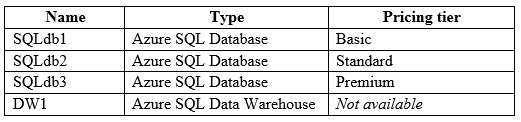
You are designing a data retention policy.
You need to identify which databases can retain a daily backup for up to 35 days and which databases can retain monthly backups for up to 120 months.
Which databases should you identify? To answer, select the appropriate options in the answer area.
NOTE: Each correct selection is worth one point.
Hot Area: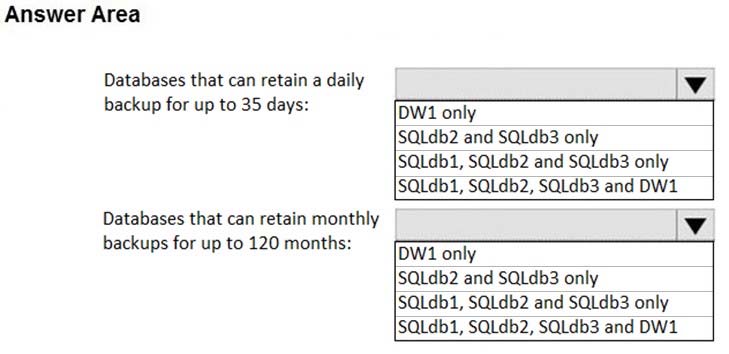
Correct Answer: