DRAG DROP -
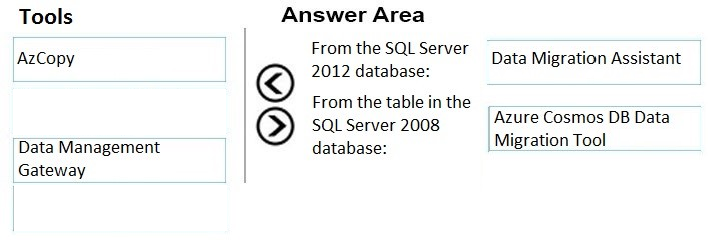
You plan to import data from your on-premises environment into Azure. The data is shown in the following table.
What should you recommend using to migrate the data? To answer, drag the appropriate tools to the correct data sources. Each tool may be used once, more than once, or not at all. You may need to drag the split bar between panes or scroll to view content.
NOTE: Each correct selection is worth one point.
Select and Place: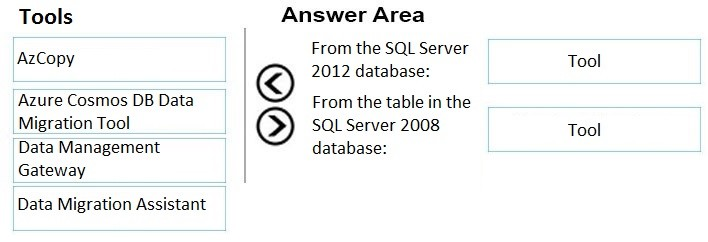
Correct Answer:
References:
https://docs.microsoft.com/en-us/azure/dms/tutorial-sql-server-to-azure-sql https://docs.microsoft.com/en-us/azure/cosmos-db/import-data
You have an on-premises deployment of MongoDB.
You plan to migrate MongoDB to an Azure Cosmos DB account that uses the MongoDB API.
You need to recommend a solution for migrating MongoDB to Azure Cosmos DB.
What should you include in the recommendation?
Correct Answer:
A
References:
https://docs.microsoft.com/en-us/azure/cosmos-db/mongodb-migrate
Your company plans to publish APIs for its services by using Azure API Management.
You discover that service responses include the AspNet-Version header.
You need to recommend a solution to remove AspNet-Version from the response of the published APIs.
What should you include in the recommendation?
Correct Answer:
C
References:
https://docs.microsoft.com/en-us/azure/api-management/transform-api
Your company has 300 virtual machines hosted in a Vmware environment. The virtual machines vary in size and have various utilization levels.
You plan to move all the virtual machines to Azure.
You need to recommend how many and what size Azure virtual machines will be required to move the current workloads to Azure. The solution must minimize administrative effort.
What should you use to make the recommendation?
Correct Answer:
B
Note: This question is part of series of questions that present the same scenario. Each question in the series contains a unique solution that might meet the stated goals. Some question sets might have more than one correct solution, while others might not have a correct solution.
After you answer a question in this section, you will NOT be able to return to it. As a result, these questions will not appear in the review screen.
You are designing an Azure solution for a company that wants to move a .NET Core web application from an on-premises data center to Azure. The web application relies on a Microsoft SQL Server 2016 database on Windows Server 2016. The database server will not move to Azure.
A separate networking team is responsible for configuring network permissions.
The company uses Azure ExpressRoute and has an ExpressRoute gateway connected to an Azure virtual network named VNET1.
You need to recommend a solution for deploying the web application.
Solution:
Deploy the web application to a web app hosted in a Standard App Service plan. Create and configure an Azure App Service Hybrid Connections endpoint.
On the on-premises network, deploy the Hybrid Connection Manager. Configure the Hybrid Connection Manager to access both the Hybrid Connection endpoint and the SQL Server instance.
Does this meet the goal?
Correct Answer:
B
Instead, use VNet Integration.
Note: VNet Integration gives your web app access to resources in your virtual network. VNet Integration is often used to enable access from apps to a databases and web services running in your VNet.
References:
https://docs.microsoft.com/en-us/azure/app-service/web-sites-integrate-with-vnet