HOTSPOT -
You have the Free edition of a hybrid Azure Active Directory (Azure AD) tenant. The tenant uses password hash synchronization.
You need to recommend a solution to meet the following requirements:
✑ Prevent Active Directory domain user accounts from being locked out as the result of brute force attacks targeting Azure AD user accounts.
✑ Block legacy authentication attempts to Azure AD integrated apps.
✑ Minimize costs.
What should you recommend for each requirement? To answer, select the appropriate options in the answer area.
NOTE: Each correct selection is worth one point.
Hot Area: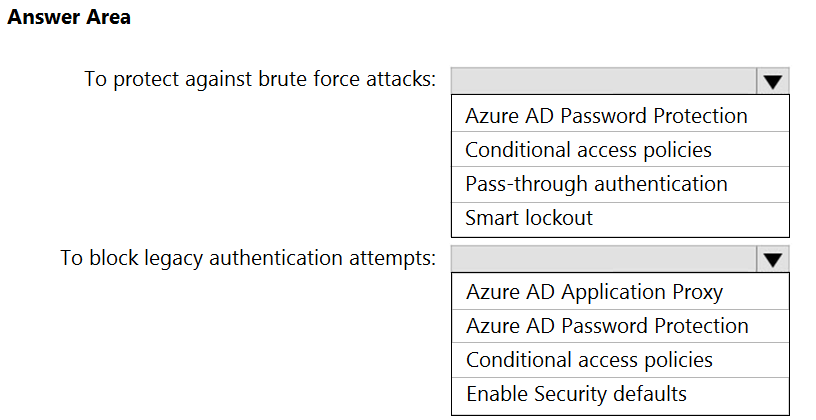
Correct Answer:
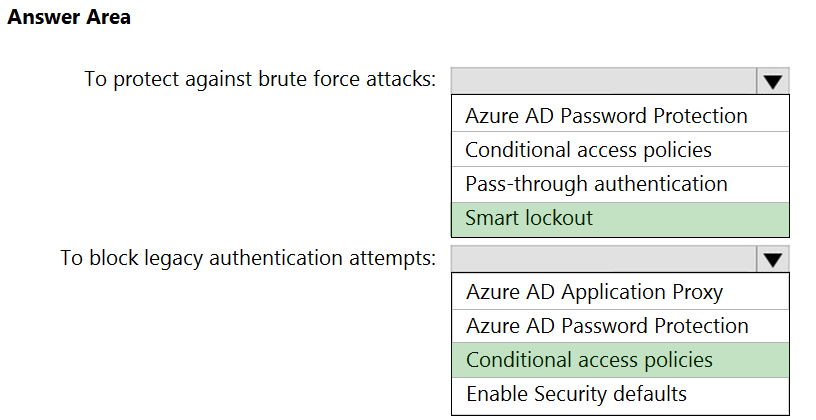
Box 1: Smart lockout -
Smart lockout helps lock out bad actors that try to guess your users' passwords or use brute-force methods to get in. Smart lockout can recognize sign-ins that come from valid users and treat them differently than ones of attackers and other unknown sources. Attackers get locked out, while your users continue to access their accounts and be productive.
Box 2: Conditional access policies
If your environment is ready to block legacy authentication to improve your tenant's protection, you can accomplish this goal with Conditional Access.
How can you prevent apps using legacy authentication from accessing your tenant's resources? The recommendation is to just block them with a Conditional
Access policy. If necessary, you allow only certain users and specific network locations to use apps that are based on legacy authentication.
Reference:
https://docs.microsoft.com/en-us/azure/active-directory/authentication/howto-password-smart-lockout https://docs.microsoft.com/en-us/azure/active-directory/conditional-access/block-legacy-authentication
You have an Azure Active Directory (Azure AD) tenant named contoso.com that contains several administrative user accounts.
You need to recommend a solution to identify which administrative user accounts have NOT signed in during the previous 30 days.
Which service should you include in the recommendation?
Correct Answer:
A
A company deploys Azure Active Directory (Azure AD) Connect to synchronize identity information from their on-premises Active Directory Domain Services (AD
DS) directory to their Azure AD tenant. The identity information that is synchronized includes user accounts, credential hashes for authentication (password sync), and group memberships. The company plans to deploy several Windows and Linux virtual machines (VMs) to support their applications.
The VMs have the following requirements:
✑ Support domain join, LDAP read, LDAP bind, NTLM and Kerberos authentication, and Group Policy.
✑ Allow users to sign in to the domain using their corporate credentials and connect remotely to the VM by using Remote Desktop.
You need to support the VM deployment.
Which service should you use?
Correct Answer:
D
Azure AD Domain Services provides managed domain services such as domain join, group policy, LDAP, Kerberos/NTLM authentication that are fully compatible with Windows Server Active Directory.
Reference:
https://docs.microsoft.com/en-us/azure/active-directory-domain-services/active-directory-ds-overview
HOTSPOT -
You are designing a software as a service (SaaS) application that will enable Azure Active Directory (Azure AD) users to create and publish online surveys. The
SaaS application will have a front-end web app and a back-end web API. The web app will rely on the web API to handle updates to customer surveys.
You need to design an authorization flow for the SaaS application. The solution must meet the following requirements:
✑ To access the back-end web API, the web app must authenticate by using OAuth 2 bearer tokens.
✑ The web app must authenticate by using the identities of individual users.
What should you include in the solution? To answer, select the appropriate options in the answer area.
NOTE: Each correct selection is worth one point.
Hot Area: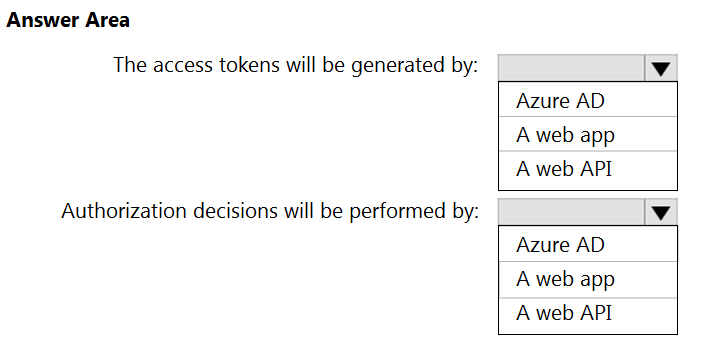
Correct Answer:
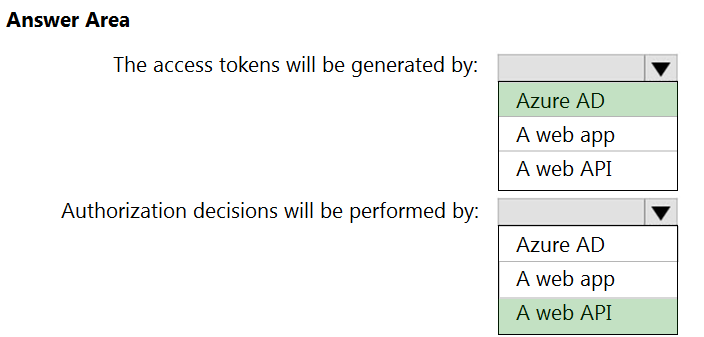
Reference:
https://docs.microsoft.com/lb-lu/azure/architecture/multitenant-identity/web-api https://docs.microsoft.com/en-us/azure/active-directory/develop/quickstart-v1-dotnet-webapi