You have an application named App1. App1 generates log files that must be archived for five years. The log files must be readable by App1 but must not be modified.
Which storage solution should you recommend for archiving?
You have 100 Microsoft SQL Server Integration Services (SSIS) packages that are configured to use 10 on-premises SQL Server databases as their destinations.
You plan to migrate the 10 on-premises databases to Azure SQL Database.
You need to recommend a solution to host the SSIS packages in Azure. The solution must ensure that the packages can target the SQL Database instances as their destinations.
What should you include in the recommendation?
HOTSPOT -
You are planning an Azure Storage solution for sensitive data. The data will be accessed daily. The data set is less than 10 GB.
You need to recommend a storage solution that meets the following requirements:
✑ All the data written to storage must be retained for five years.
✑ Once the data is written, the data can only be read. Modifications and deletion must be prevented.
✑ After five years, the data can be deleted, but never modified.
✑ Data access charges must be minimized.
What should you recommend? To answer, select the appropriate options in the answer area.
NOTE: Each correct selection is worth one point.
Hot Area: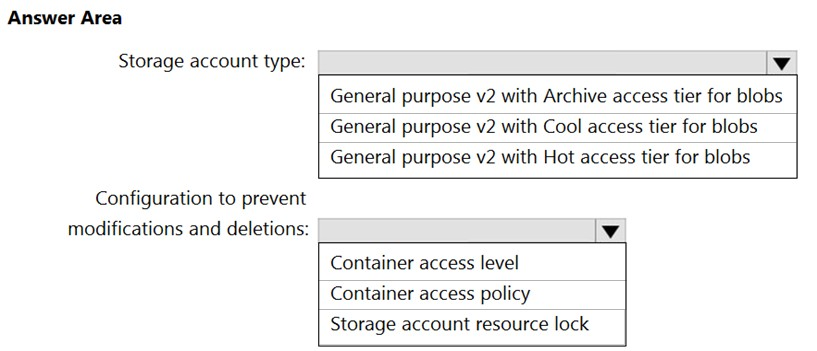
Correct Answer:
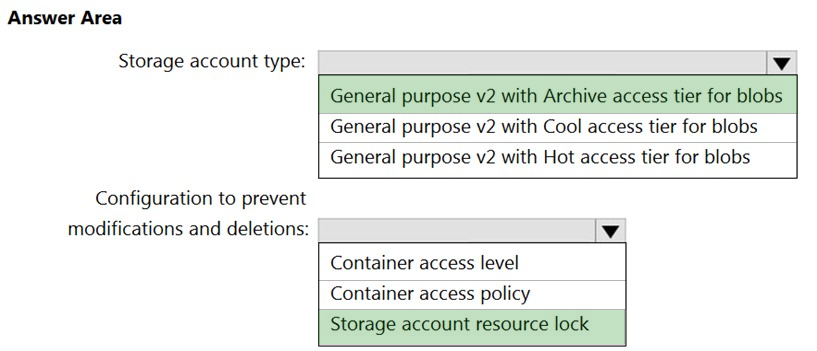
Box 1: General purpose v2 with Archive acce3ss tier for blobs
Archive - Optimized for storing data that is rarely accessed and stored for at least 180 days with flexible latency requirements, on the order of hours.
Cool - Optimized for storing data that is infrequently accessed and stored for at least 30 days.
Hot - Optimized for storing data that is accessed frequently.
Box 2: Storage account resource lock
As an administrator, you can lock a subscription, resource group, or resource to prevent other users in your organization from accidentally deleting or modifying critical resources. The lock overrides any permissions the user might have.
Note: You can set the lock level to CanNotDelete or ReadOnly. In the portal, the locks are called Delete and Read-only respectively.
✑ CanNotDelete means authorized users can still read and modify a resource, but they can't delete the resource.
✑ ReadOnly means authorized users can read a resource, but they can't delete or update the resource. Applying this lock is similar to restricting all authorized users to the permissions granted by the Reader role.
Reference:
https://docs.microsoft.com/en-us/azure/storage/blobs/storage-blob-storage-tiers
You have an Azure subscription. The subscription contains an app that is hosted in the East US, Central Europe, and East Asia regions.
You need to recommend a data-tier solution for the app. The solution must meet the following requirements:
✑ Support multiple consistency levels.
✑ Be able to store at least 1 TB of data.
✑ Be able to perform read and write operations in the Azure region that is local to the app instance.
What should you include in the recommendation?