DRAG DROP -
Your company identifies the following business continuity and disaster recovery objectives for virtual machines that host sales, finance, and reporting applications in the companyג€™s on-premises data center:
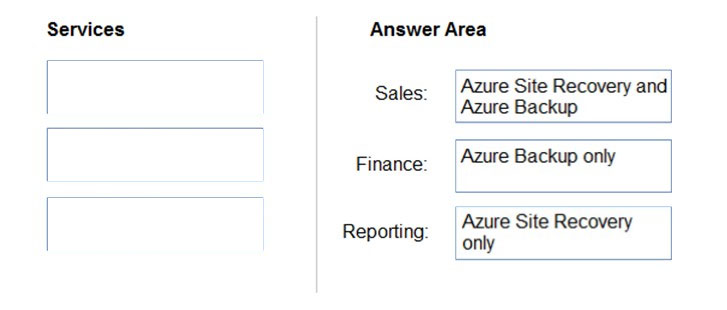
✑ The sales application must be able to fail over to a second on-premises data center.
✑ The finance application requires that data be retained for seven years. In the event of a disaster, the application must be able to run from Azure. The recovery time objective (RTO) is 10 minutes.
✑ The reporting application must be able to recover point-in-time data at a daily granularity. The RTO is eight hours.
You need to recommend which Azure services meet the business continuity and disaster recovery objectives. The solution must minimize costs.
What should you recommend for each application? To answer, drag the appropriate services to the correct applications. Each service may be used once, more than once, or not at all. You may need to drag the split bar between panes or scroll to view content.
NOTE: Each correct selection is worth one point.
Select and Place: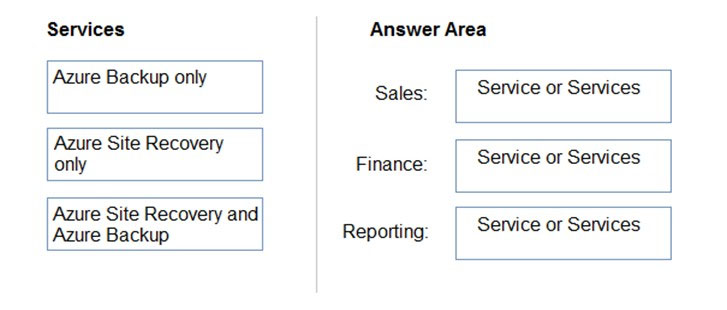
Correct Answer:
You have an Azure Storage v2 account named storage1.
You plan to archive data to storage1.
You need to ensure that the archived data cannot be deleted for five years. The solution must prevent administrators from deleting the data.
What should you do?
Correct Answer:
D
Time-based retention policy support: Users can set policies to store data for a specified interval. When a time-based retention policy is set, blobs can be created and read, but not modified or deleted. After the retention period has expired, blobs can be deleted but not overwritten.
Note:
Immutable storage for Azure Blob storage enables users to store business-critical data objects in a WORM (Write Once, Read Many) state. This state makes the data non-erasable and non-modifiable for a user-specified interval. For the duration of the retention interval, blobs can be created and read, but cannot be modified or deleted. Immutable storage is available for general-purpose v2 and Blob storage accounts in all Azure regions.
Reference:
https://docs.microsoft.com/en-us/azure/storage/blobs/storage-blob-immutable-storage
HOTSPOT -
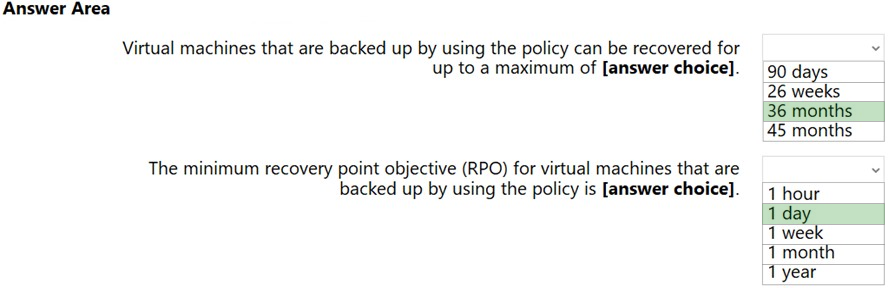
You plan to deploy the backup policy shown in the following exhibit.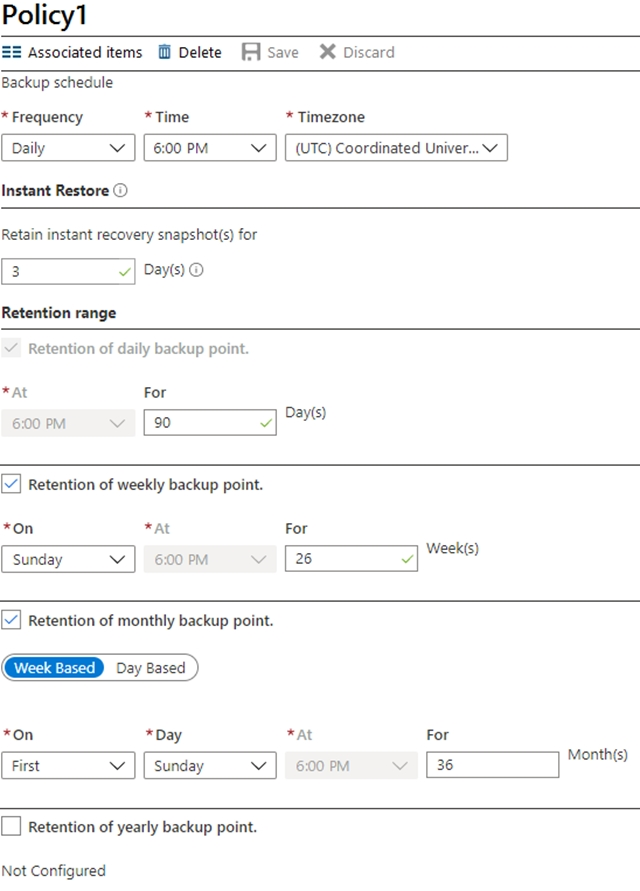
Use the drop-down menus to select the answer choice that completes each statement based on the information presented in the graphic.
NOTE: Each correct selection is worth one point.
Hot Area: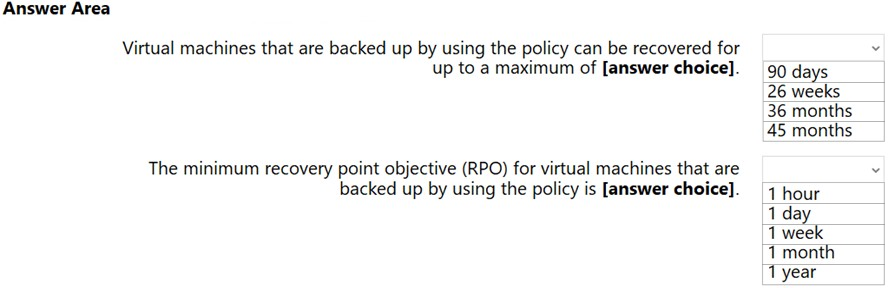
Correct Answer:
HOTSPOT -
You have an Azure web app named App1 and an Azure key vault named KV1.
App1 stores database connection strings in KV1.
App1 performs the following types of requests to KV1:
✑ Get
✑ List
✑ Wrap
✑ Delete
✑ Unwrap
✑ Backup
✑ Decrypt
✑ Encrypt
You are evaluating the continuity of service for App1.
You need to identify the following if the Azure region that hosts KV1 becomes unavailable:
✑ To where will KV1 fail over?
✑ During the failover, which request type will be unavailable?
What should you identify? To answer, select the appropriate options in the answer area.
NOTE: Each correct selection is worth one point.
Hot Area: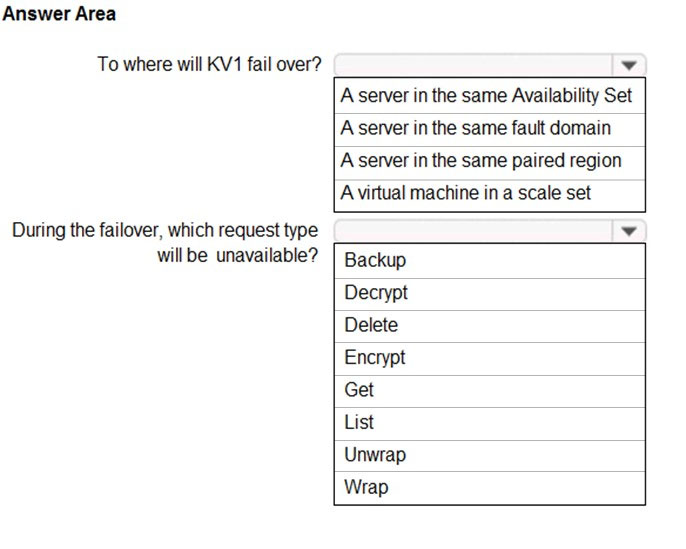
Correct Answer:
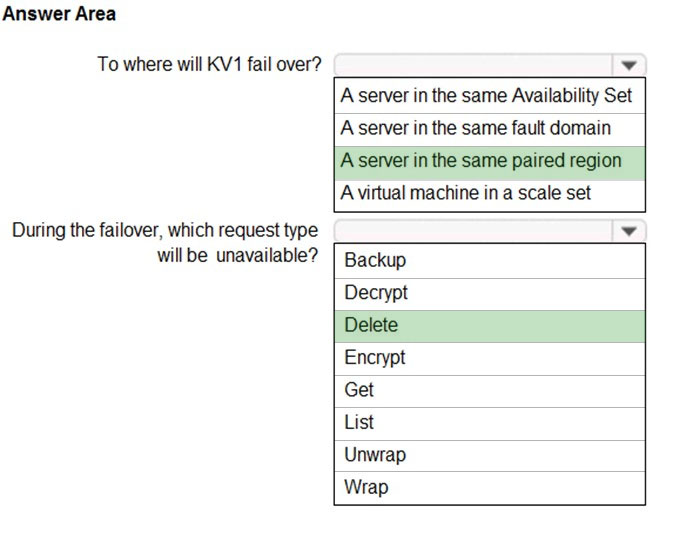
Box 1: A server in the same paired region
The contents of your key vault are replicated within the region and to a secondary region at least 150 miles away, but within the same geography to maintain high durability of your keys and secrets.
Box 2: Delete -
During failover, your key vault is in read-only mode. Requests that are supported in this mode are:
✑ List certificates
✑ Get certificates
✑ List secrets
✑ Get secrets
✑ List keys
✑ Get (properties of) keys
✑ Encrypt
✑ Decrypt
✑ Wrap
✑ Unwrap
✑ Verify
✑ Sign
✑ Backup
Reference:
https://docs.microsoft.com/en-us/azure/key-vault/general/disaster-recovery-guidance