DRAG DROP -
Your company has users who work remotely from laptops.
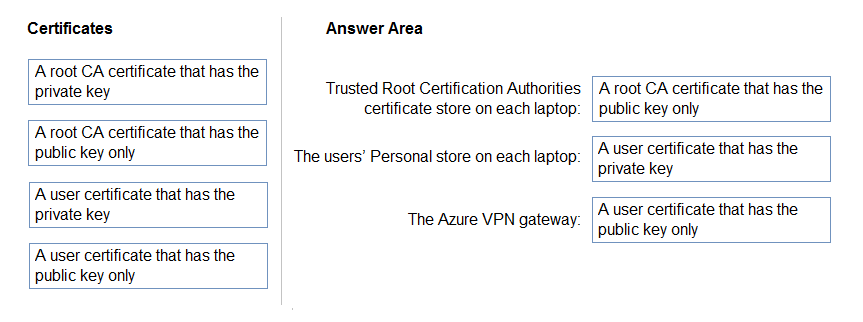
You plan to move some of the applications accessed by the remote users to Azure virtual machines. The users will access the applications in Azure by using a point-to-site VPN connection. You will use certificates generated from an on-premises-based Certification authority (CA).
You need to recommend which certificates are required for the deployment.
What should you include in the recommendation? To answer, drag the appropriate certificates to the correct targets. Each certificate may be used once, more than once, of not at all. You may need to drag the split bar between panes or scroll to view content.
NOTE: Each correct selection is worth one point.
Select and Place: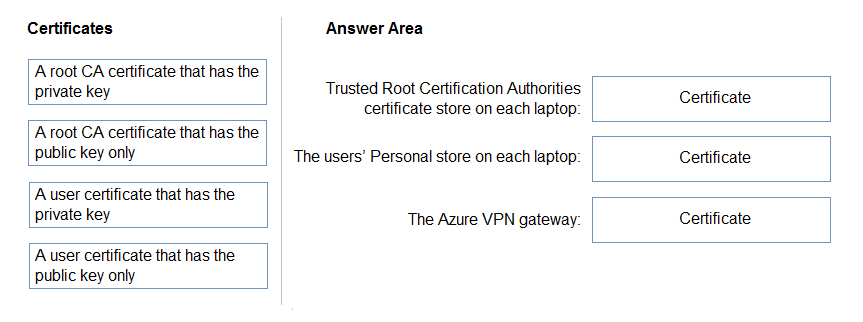
Correct Answer:
HOTSPOT -
You are building an application that will run in a virtual machine (VM). The application will use Azure Managed Identity.
The application uses Azure Key Vault, Azure SQL Database, and Azure Cosmos DB.
You need to ensure the application can use secure credentials to access these services.
Which authorization method should you recommend? To answer, select the appropriate options in the answer area.
NOTE: Each correct selection is worth one point.
Hot Area: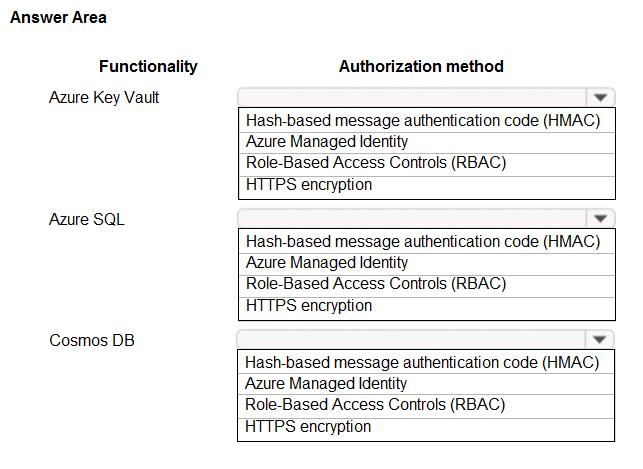
Correct Answer:
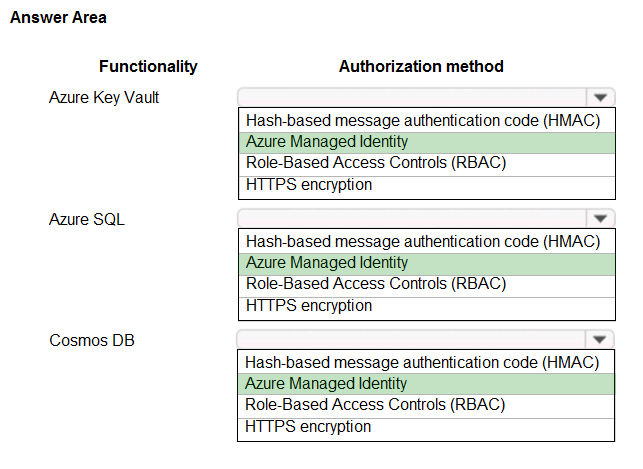
Note: Managed identities for Azure resources is the new name for the service formerly known as Managed Service Identity (MSI).
Reference:
https://docs.microsoft.com/en-us/azure/active-directory/managed-identities-azure-resources/overview
You have an Azure subscription that contains a custom application named Application1. Application1 was developed by an external company named Fabrikam,
Ltd. Developers at Fabrikam were assigned role-based access control (RBAC) permissions to the Application1 components. All users are licensed for the
Microsoft 365 E5 plan.
You need to recommend a solution to verify whether the Fabrikam developers still require permissions to Application1. The solution must meet the following requirements:
✑ To the manager of the developers, send a monthly email message that lists the access permissions to Application1.
✑ If the manager does not verify an access permission, automatically revoke that permission.
✑ Minimize development effort.
What should you recommend?
Correct Answer:
C
DRAG DROP -
A company named Contoso, Ltd. has an Azure Active Directory (Azure AD) tenant that uses the Basic license.
You plan to deploy two applications to Azure. The applications have the requirements shown in the following table.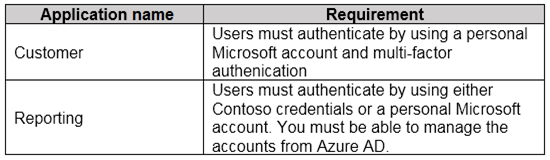
Which authentication strategy should you recommend for each application? To answer, drag the appropriate authentication strategies to the correct applications.
Each authentication strategy may be used once, more than once, or not at all. You may need to drag the split bar between panes or scroll to view content.
NOTE: Each correct selection is worth one point.
Select and Place: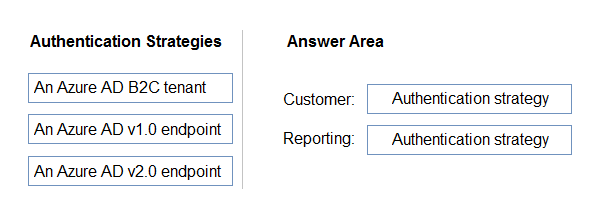
Correct Answer:
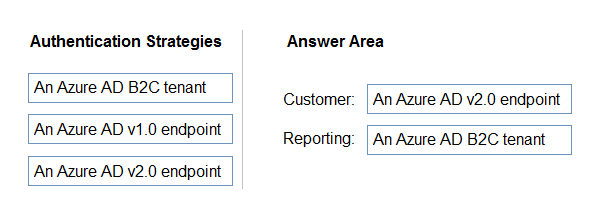
Box 1: Azure AD V2.0 endpoint -
Microsoft identity platform is an evolution of the Azure Active Directory (Azure AD) developer platform. It allows developers to build applications that sign in all
Microsoft identities and get tokens to call Microsoft APIs, such as Microsoft Graph, or APIs that developers have built. The Microsoft identity platform consists of:
OAuth 2.0 and OpenID Connect standard-compliant authentication service that enables developers to authenticate any Microsoft identity, including:
Work or school accounts (provisioned through Azure AD)
Personal Microsoft accounts (such as Skype, Xbox, and Outlook.com)
Social or local accounts (via Azure AD B2C)
Box 2: Azure AD B2C tenant -
Azure Active Directory B2C provides business-to-customer identity as a service. Your customers use their preferred social, enterprise, or local account identities to get single sign-on access to your applications and APIs.
Azure Active Directory B2C (Azure AD B2C) integrates directly with Azure Multi-Factor Authentication so that you can add a second layer of security to sign-up and sign-in experiences in your applications.
Reference:
https://docs.microsoft.com/en-us/azure/active-directory-b2c/active-directory-b2c-reference-mfa https://docs.microsoft.com/en-us/azure/active-directory/develop/v2-overview