HOTSPOT -
You manage a network that includes an on-premises Active Directory domain and an Azure Active Directory (Azure AD).
Employees are required to use different accounts when using on-premises or cloud resources. You must recommend a solution that lets employees sign in to all company resources by using a single account. The solution must implement an identity provider.
You need to provide guidance on the different identity providers.
How should you describe each identity provider? To answer, select the appropriate description from each list in the answer area.
NOTE: Each correct selection is worth one point.
Hot Area: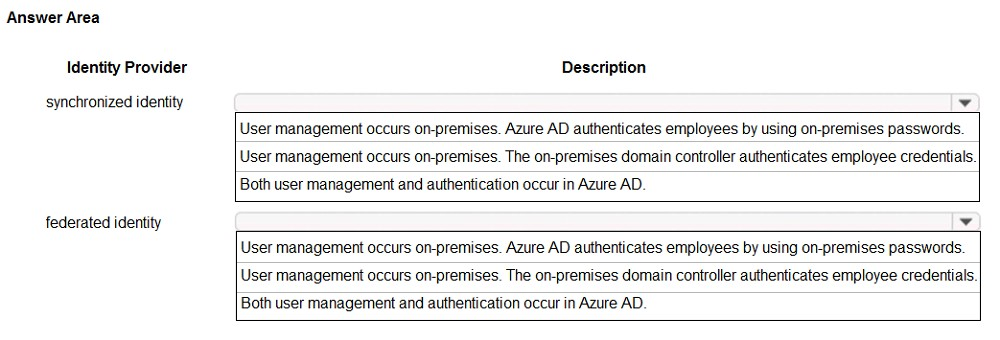
Correct Answer:
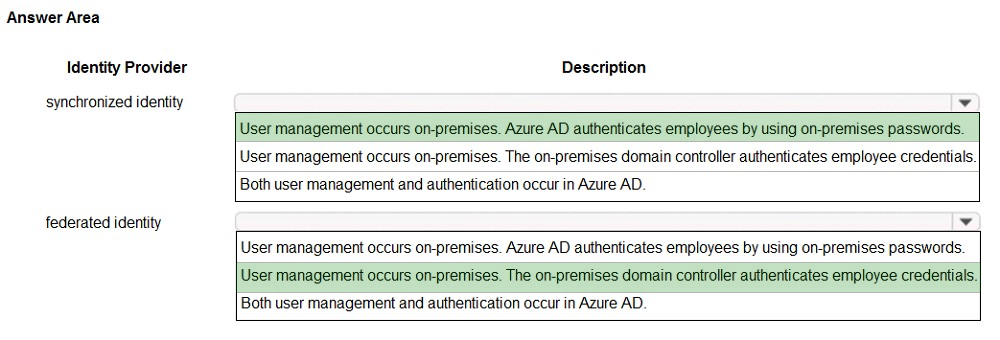
Box1: User management occurs on-premises. Azure AD authenticates employees by using on-premises passwords.
Azure AD Domain Services for hybrid organizations
Organizations with a hybrid IT infrastructure consume a mix of cloud resources and on-premises resources. Such organizations synchronize identity information from their on-premises directory to their Azure AD tenant. As hybrid organizations look to migrate more of their on-premises applications to the cloud, especially legacy directory-aware applications, Azure AD Domain Services can be useful to them.
Example: Litware Corporation has deployed Azure AD Connect, to synchronize identity information from their on-premises directory to their Azure AD tenant. The identity information that is synchronized includes user accounts, their credential hashes for authentication (password hash sync) and group memberships.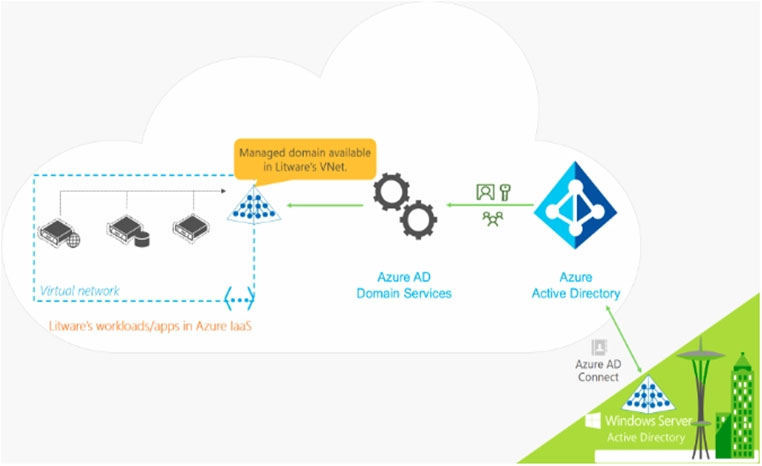
User accounts, group memberships, and credentials from Litware's on-premises directory are synchronized to Azure AD via Azure AD Connect. These user accounts, group memberships, and credentials are automatically available within the managed domain.
Box 2: User management occurs on-premises. The on-promises domain controller authenticates employee credentials.
You can federate your on-premises environment with Azure AD and use this federation for authentication and authorization. This sign-in method ensures that all user authentication occurs on-premises.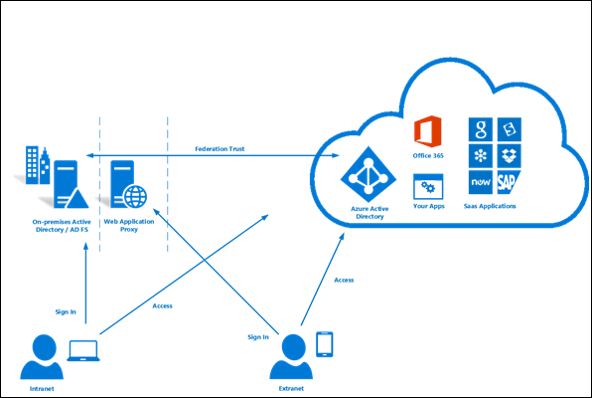
Reference:
https://docs.microsoft.com/en-us/azure/active-directory-domain-services/active-directory-ds-overview https://docs.microsoft.com/en-us/azure/active-directory/hybrid/whatis-fed
HOTSPOT -
You configure the Diagnostics settings for an Azure SQL database as shown in the following exhibit.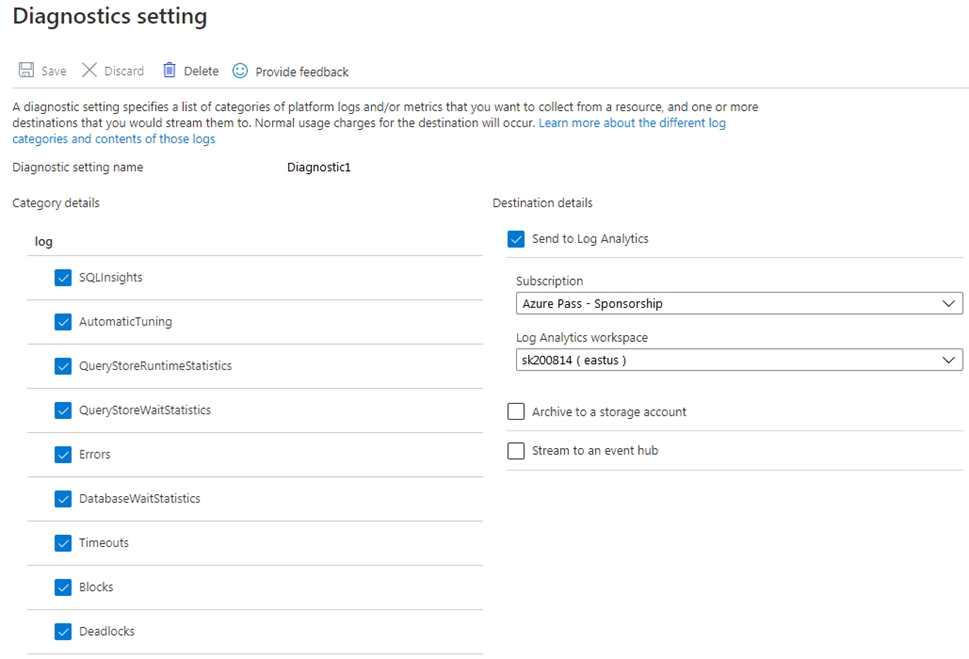
Use the drop-down menus to select the answer choice that completes each statement based on the information presented in the graphic.
NOTE: Each correct selection is worth one point.
Hot Area: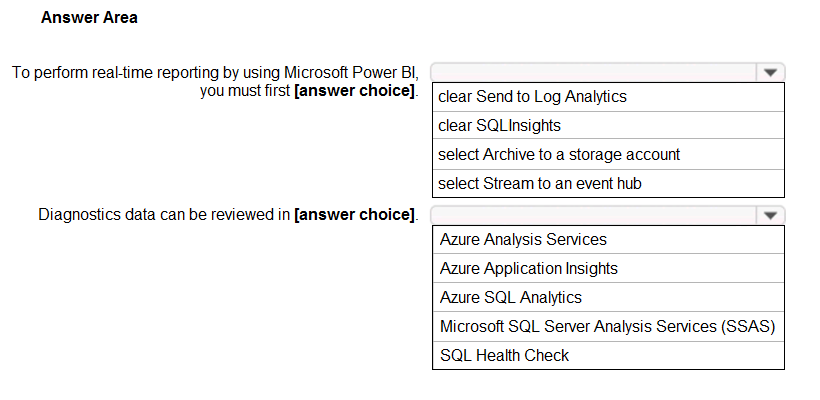
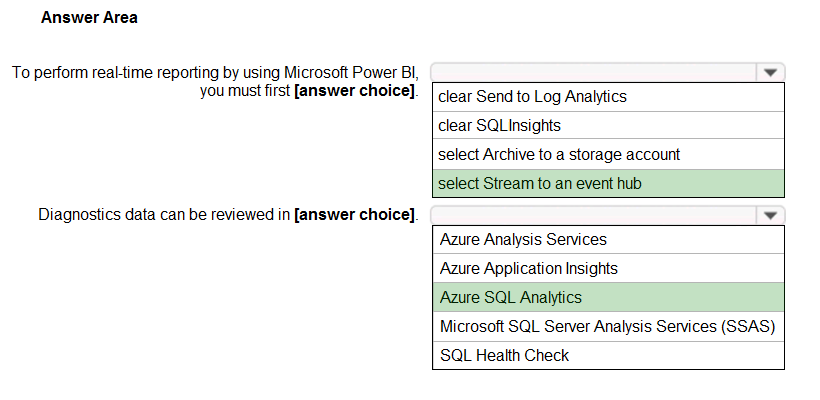
Correct Answer:
You plan to deploy an application named App1 that will run on five Azure virtual machines. Additional virtual machines will be deployed later to run App1.
You need to recommend a solution to meet the following requirements for the virtual machines that will run App1:
✑ Ensure that the virtual machines can authenticate to Azure Active Directory (Azure AD) to gain access to an Azure key vault, Azure Logic Apps instances, and an Azure SQL database.
✑ Avoid assigning new roles and permissions for Azure services when you deploy additional virtual machines.
✑ Avoid storing secrets and certificates on the virtual machines.
✑ Minimize administrative effort for managing identities.
Which type of identity should you include in the recommendation?
Correct Answer:
D
Managed identities for Azure resources is a feature of Azure Active Directory.
User-assigned managed identity can be shared. The same user-assigned managed identity can be associated with more than one Azure resource.
Incorrect Answers:
B: System-assigned managed identity cannot be shared. It can only be associated with a single Azure resource.
Reference:
https://docs.microsoft.com/en-us/azure/active-directory/managed-identities-azure-resources/overview
You are designing a large Azure environment that will contain many subscriptions.
You plan to use Azure Policy as part of a governance solution.
To which three scopes can you assign Azure Policy definitions? Each correct answer presents a complete solution.
NOTE: Each correct selection is worth one point.
Correct Answer:
ABD
Azure Policy evaluates resources in Azure by comparing the properties of those resources to business rules. Once your business rules have been formed, the policy definition or initiative is assigned to any scope of resources that Azure supports, such as management groups, subscriptions, resource groups, or individual resources.
Reference:
https://docs.microsoft.com/en-us/azure/governance/policy/overview